This article may contain affiliate links, meaning we make a small commission on any purchases or bookings at no extra expense to you. For more info read our disclaimer & privacy policy here.
Understand breakfast culture in Italy and what you can expect from your trip. It's likely far more more simple than what you might be thinking.
Raf and I are both breakfast people. More often than not, I wake up hungry and while Raf needs an hour to two before he's ready, he wants a feast more than just a piece of toast.
Culturally, I'm from the US, the land of brunch, and Raf is from Colombia, where breakfast is often the biggest meal of the day. When we first started dating, we bonded over our love of breakfast food and still, 10 years later, never skip it.
Moving to Italy and embracing their idea of breakfast was a shock to our bellies.
We thrived when we lived in Vietnam where bowls of noodles were eaten at street carts as early as 6am or the king of the breakfast sandwich, the banh mi, was readily available any hour of the day. Moving to the Balkans was also good for us since a massive pita or byrek (depending on the country) filled us up.
Then came the Italian breakfast.
And although we've gotten used to it in the few years we've lived here and I even crave it sometimes, it's something we always prepare our guests for. Expectations need to be set because if you're thinking you can just pop down to any cafe for a plate of scrambled eggs or something similar, more often than not, you're out of luck.
So, let me walk you through what breakfast in Italy really looks like and a few tricks to navigate around this if needed.
Short on time? Here's the quick guide:
Breakfast in Italy is a simple affair. Expect a pastry and a coffee with little else to choose from. More often than not, expect sweet pastries rather than savory options.
Any bar or caffè will offer this so you don't need to look too hard to try a local breakfast.
If you can't handle the idea of something so small for breakfast, look for somewhere serving "brunch" instead.
About us
We're Kat, from the US, & Raf, from Colombia. We've been traveling the world and living abroad for the past decade but now call Italy home.
Breakfast Foods & Drinks in Italy
The window at a typical bar in Rome
A typical Italian breakfast means a pastry and coffee. Simple as can be. Breakfast is almost always sweet, never savory, unless you stumble upon a cafe that also sells panini (sandwiches) or are around Reggio Emilia and can try erbazzone (described below).
Before I share where to find some alternatives to a traditional Italian breakfast, I want to describe what you'll most commonly see.
Breakfast Pastries
The pastry choices will vary from region to region with each one offering up their favorite.
From our experience, the only pastry that can be found easily throughout the entire country is a croissant. Just know that in Italian, a croissant is called either a cornetto (most common in center and south) or a brioche (most common in north). Often the croissants are filled with either chocolate, pistachio cream (the best!), or jam.
A few of our favorite regional pastries to try though if you happen to be in one of these areas are:
Maritozzi: Common in Lazio; essentially a sweet bun filled with whipped cream.
Bombolone: Common in Tuscany; Like a donut, usually filled with cream.
Sfogliatella Frolla: Common in Campania; Like a shortbread biscuit. Just note there's also the sfogliatella riccia but I much prefer the frolla.
Risino: Common in Veneto; This is creamy, sweet rice-filled pastry that's a lot better than it sounds.
Erbazzone: Common in Emilia-Romagna; The only savory breakfast option I've found and my absolute favorite. This is a spinach and cheese filled pastry.
You're right if you're thinking Italian breakfast is made for those with a sweet tooth.
Breakfast Drinks
Almost always locals will enjoy their pastry with a coffee. Just know, if you're imagining a big American brew, think again.
Coffee here is often an espresso or cappuccino. Again, there are regional specialties but you can always count on an espresso or cappuccino to get your day started.
If you prefer milk in your coffee, remember that "latte" simply means milk, so you'll want to be sure to order a "caffè latte" unless you really do just want a glass of hot milk. On the milk note, dairy alternatives aren't really a thing in Italy. You won't find oat milk, almond milk, or something along those lines at 99% of cafes. Maybe you will at a specialty coffee shop in a bigger city but I wouldn't count on it everywhere.
A lot of cafes will also offer freshly squeezed orange juice but note that the price for a juice is often double (if not more) than a coffee, if you're watching your budget.
Some locals might also start their day off with a wine but at least where we live and have traveled, I haven't seen people drinking much stronger than that, unless it's a late breakfast on the weekend. An exception to this is a caffè corretto, which is an espresso with a shot of grappa in it.
Where to Eat Breakfast in Italy
A risino and cappucino in Verona
Breakfast in Italy is found at either a "caffè" or a "bar." While it might feel wrong to start your day at the local bar, in Italy the words are essentially synonymous. A bar of caffè will stay open all day, always serving both coffees and alcohol.
In the morning, these places will most often have pastries behind the counter and as the day gets later, they'll switch it up to offer panini or other snacks. Sometimes you can find a pastry in the evening but likely that one is just leftover from the morning rush.
So, if you're walking around a new area in Italy and are looking for a pastry and coffee to start your day, head to any bar or caffè and you'll find what you're looking for. Italians prioritize quality over anything else when it comes to food so no need to stress over which bar you choose, most will make a great coffee and a fresh pastry. Believe it or not, even gas stations do a good job with this if you happen to be on the road.
Another option is to go to a bakery, or panificio. This is the best bet for an affordable breakfast that'll offer more variety, especially if you want something savory. Know that it'll still be baked goods but will still have a little bit more to choose from than what the bar or caffè has.
How to Order Like a Local
When you go to a local bar, you'll likely see a mix of people standing at the counter and others sitting at a table.
From our experience, you always order at the counter and then you can decide if you would prefer to sit or stand. If you stand at the bar, know that this is for a quicker meal and you're not meant to hang out too long. The price is often cheaper and the service immediate.
If you'd prefer to sit, after ordering, you can usually go and sit down and someone from the staff will bring you what you ordered when it's ready. To pay, you almost always need to go back to the counter to do so.
Italy's Meaning of Brunch
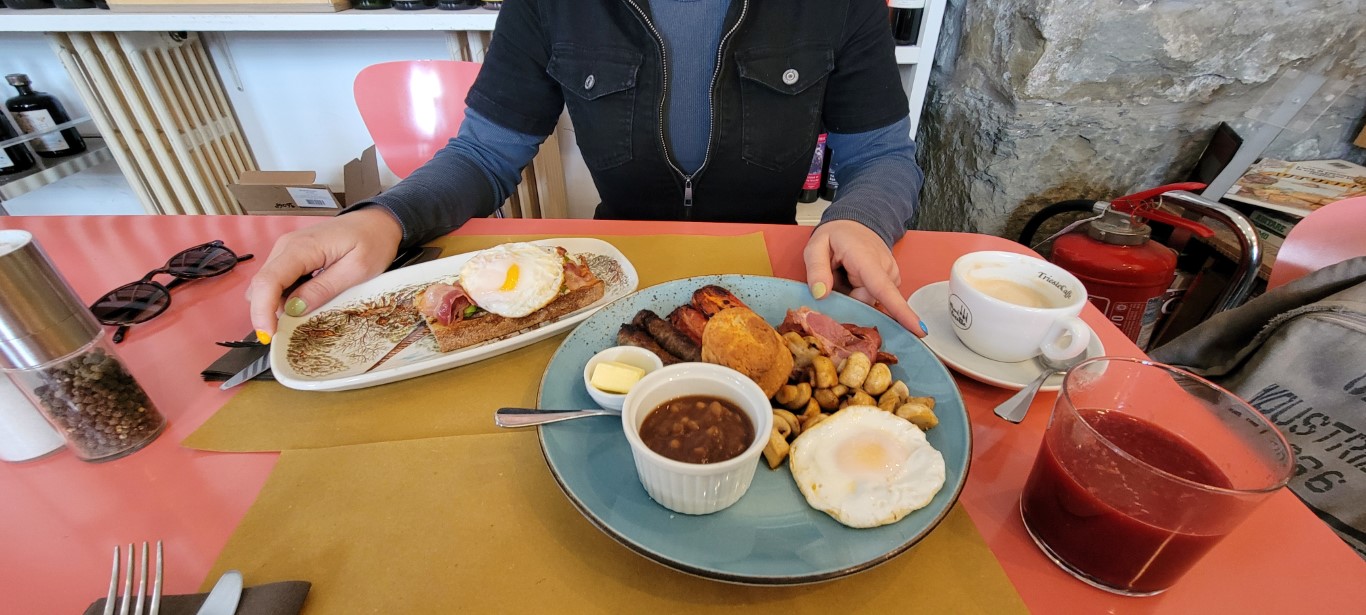
Brunch at restaurant in Trieste
Now, for those that are reading this and thinking this can't be all there is in Italy, well, you're right. There is a workaround for those that are craving eggs, waffles, or something hearty. And that's at a brunch spot.
Before you worry that I'm making you wait until 11am to eat, know that Italy has a slightly different definition of brunch than at least people from the US do.
For Italians, brunch just means an Americanized breakfast. Brunch places sometimes open for breakfast and lunch and others stay open all day.
The easiest way to find these is just to search for "brunch" in Google Maps and see what pops up.
I will say, some restaurants only offer brunch on the weekends and build it into their normal lunch menu but I've seen more and more places popping up with "brunch" in the name of their restaurant and offer essentially a breakfast menu all day.
This is your best bet to get the bigger breakfast you might be craving.
What "Breakfast Included" Means at Hotels in Italy
Another workaround is to stay at a hotel that offers breakfast. Just know that not all hotel breakfasts will mean something hot and fresh from the kitchen. Just like in most countries, there are tiers to the breakfast buffet, from yogurt and boxes of cereal to cooked sausages, bacon, and eggs.
Just because a hotel offers breakfast, doesn't mean it'll be what you have in mind. If you're quite picky on this, I suggest looking for pictures of their breakfast or reading recent reviews to see what you can expect.
Of course, you can always book a vacation rental in Italy and make yourself breakfast. For longer stays, rental homes tend to be more comfortable. Just keep in mind that the rise of vacation rentals homes are raising the rent for locals and, in some popular cities, are starting to push them out. Whenever possible, book a boutique hotel or a family run established to help out the local community during your stay.
If you decide to stay at an agriturismo (my favorite) during your trip to Italy, you can expect a big breakfast served hot each morning.
Now You're Ready for Mornings in Italy
What breakfast from a bakery can look like
Mornings in Italy tend to move at a different rhythm. People often wake up late and walk over to their neighborhood bar for a chat, a pastry, and an espresso. They'll stand at the bar or settle in at a table to read the newspaper before heading off to work.
Local bars and caffès usually don't have waitresses that'll take your order and bring your bill to the table. They're laid-back and only offer what you can see behind the counter.
Opt for brunch if you need something heavier but I do recommend at least one morning during your trip to Italy you try out a typical Italian breakfast at a local spot near where you're staying. It's a part of the culture worth tasting for yourself. And who knows, maybe you'll love the simplicity.
Travel Italy like you live here
Get Italian travel tips straight to your inbox + 2 bonus freebies right away.
By clicking “Accept All”, you agree to the storing of cookies on your device to enhance site navigation, analyze site usage and assist in our marketing efforts as outlined in our cookie policy.